

people with ADHD in England
NHS ADHD Management Information, May 2025 ↗


- Current position: 29 July 2026. NHS England’s independent ADHD Taskforce has completed both parts of its report. NHS England has also issued service-delivery advice to local systems. A separate government review covering mental-health conditions, ADHD and autism published an interim report in June 2026, but had not yet issued final recommendations at the time of this update.
This page concerns England unless stated otherwise. Scotland, Wales and Northern Ireland have different health systems, referral routes and policy responsibilities.
The central policy direction is clear: support should begin earlier, should not depend entirely on a diagnosis, and should be shared across health, education, employment, justice and local services. The unresolved question is how consistently that direction will be funded and implemented.
Key timeline
- March 2024: NHS England announced a cross-sector ADHD Taskforce after a rapid review identified major problems with data, commissioning, access and coordination.
- November 2024: the Taskforce held its first meeting after its membership and terms of reference were developed.
- 20 June 2025: Part 1 of the independent Taskforce report was published, setting out immediate priorities and a whole-system approach.
- 6 October 2025: NHS England issued advice to integrated care boards and other systems on service delivery, waiting-list review, patient support, equality impact and safe prioritisation.
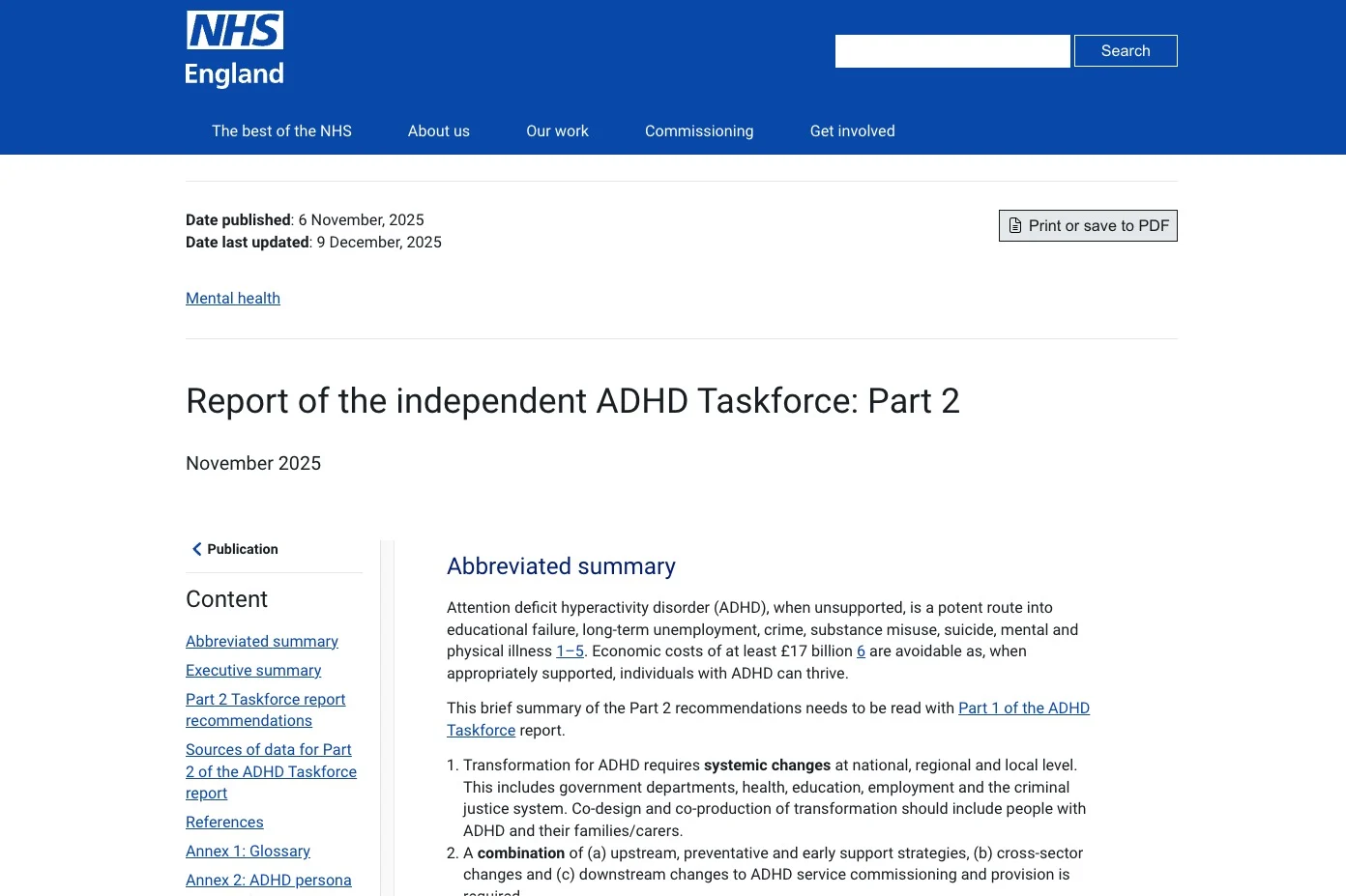
- 6 November 2025: Part 2 of the Taskforce report was published with wider implementation recommendations across health, education, employment and justice.
- 4 December 2025: the government launched a separate independent review into prevalence and support for mental-health conditions, ADHD and autism.
- 10 June 2026: that review published an interim report. It described evidence and unresolved questions but explicitly did not make final recommendations.
- July 2026: government answers continued to acknowledge severe assessment delays, local commissioning responsibility and the importance of independent-sector capacity while further review work continued.
What the ADHD Taskforce recommended
Support before diagnosis
Practical help in schools, workplaces, communities and waiting-list pathways should respond to need rather than requiring a completed diagnosis for every adjustment. Diagnosis remains necessary for some clinical decisions, including medication, but should not be the sole gateway to non-clinical support.
Integrated and stepped care
The reports call for ADHD to be managed as a common long-term condition, with stronger roles for primary care and community services supported by specialist teams. More complex cases would still require specialist input.
Better waiting-list support
People waiting for assessment should receive accurate information, risk-aware review, signposting and practical support rather than being left without contact for years. NHS England’s October 2025 advice specifically asks systems to consider patient safety and equality impacts when changing access or prioritisation.
Quality standards and better data
National and local services need more reliable information about referrals, waits, diagnosis, treatment, outcomes and inequality. Faster throughput without consistent assessment and treatment quality would not solve the underlying problem.
Shared responsibility beyond healthcare
Education, employment, justice and local government affect whether ADHD becomes disabling. The Taskforce therefore rejected a model in which specialist health services are expected to carry the whole response.
What has actually changed
- England now has a completed independent ADHD Taskforce report rather than an anticipated one.
- NHS England has issued formal advice to local systems on managing service pressure and supporting patients.
- National policy language increasingly recognises support before diagnosis, integrated care and the risks of very long waits.
- Some related work is proceeding through data improvement, school mental-health support, commissioning changes and collaboration between primary and specialist care.
- The government’s broader review has placed ADHD and autism alongside mental-health support, service demand and early intervention rather than treating them as isolated diagnostic services.
These are meaningful policy developments, but they do not amount to a completed national transformation. The Taskforce itself had no power to implement its recommendations.
What remains unresolved
- Waiting times: severe delays continue, and local figures can differ dramatically.
- Local variation: integrated care boards commission services differently and may use different providers, thresholds and referral arrangements.
- Workforce: assessment, titration, prescribing and follow-up capacity remain constrained.
- Shared care: arrangements between specialists and GPs remain inconsistent and cannot be assumed.
- Continuity after diagnosis: an assessment-only service is not the same as a pathway that includes treatment, monitoring and review.
- Children-to-adult transition: service boundaries can disrupt people already waiting or receiving treatment.
- Implementation accountability: recommendations require decisions, funding, standards and measurable oversight across several government departments.
The 2026 government review
The independent review chaired by Professor Peter Fonagy is examining why demand for mental-health, ADHD and autism assessment and support has increased, how different forms of prevalence data should be interpreted, and how earlier or different support models might work.
Its June 2026 interim report is not a final policy settlement. It identifies gaps, tensions and questions for the next phase. Claims that it has already endorsed one explanation for rising diagnoses or one model of reform go beyond the report.
What to check in your local pathway
- Which adult or child ADHD service your GP or local system currently commissions.
- Whether the pathway covers assessment only or also titration, prescribing and follow-up.
- What support is available while waiting and how risk or deterioration can be reported.
- Whether Right to Choose is available for the relevant service in England and what happens after diagnosis.
- Whether a GP is willing and clinically able to enter shared care after specialist stabilisation.
- How the pathway handles moves, transition between age services and existing private diagnoses.
ADHD Assessment PathwaysExplore common NHS, Right to Choose and private routes in England, then verify the current position locally.
ADHD and autism assessmentWhat a credible assessment should examine and what to clarify before choosing a provider.
ADHD medicationInitiation, titration, monitoring, shared care and the limits of general information.
Official sources
- NHS England — ADHD programme and Taskforce overview
- NHS England — independent ADHD Taskforce reports, summaries and accessible versions
- NHS England — ADHD service delivery and prioritisation advice to systems
- GOV.UK — independent review collection, terms of reference and interim report
- GOV.UK — June 2026 interim report
- UK Parliament — July 2026 answer on ADHD diagnostic pathways and independent providers
- NICE guideline NG87 — ADHD diagnosis and management
- Monitoring note: policy pages age quickly. Check the publication date on each official source and confirm local arrangements directly before acting.